

Introduction
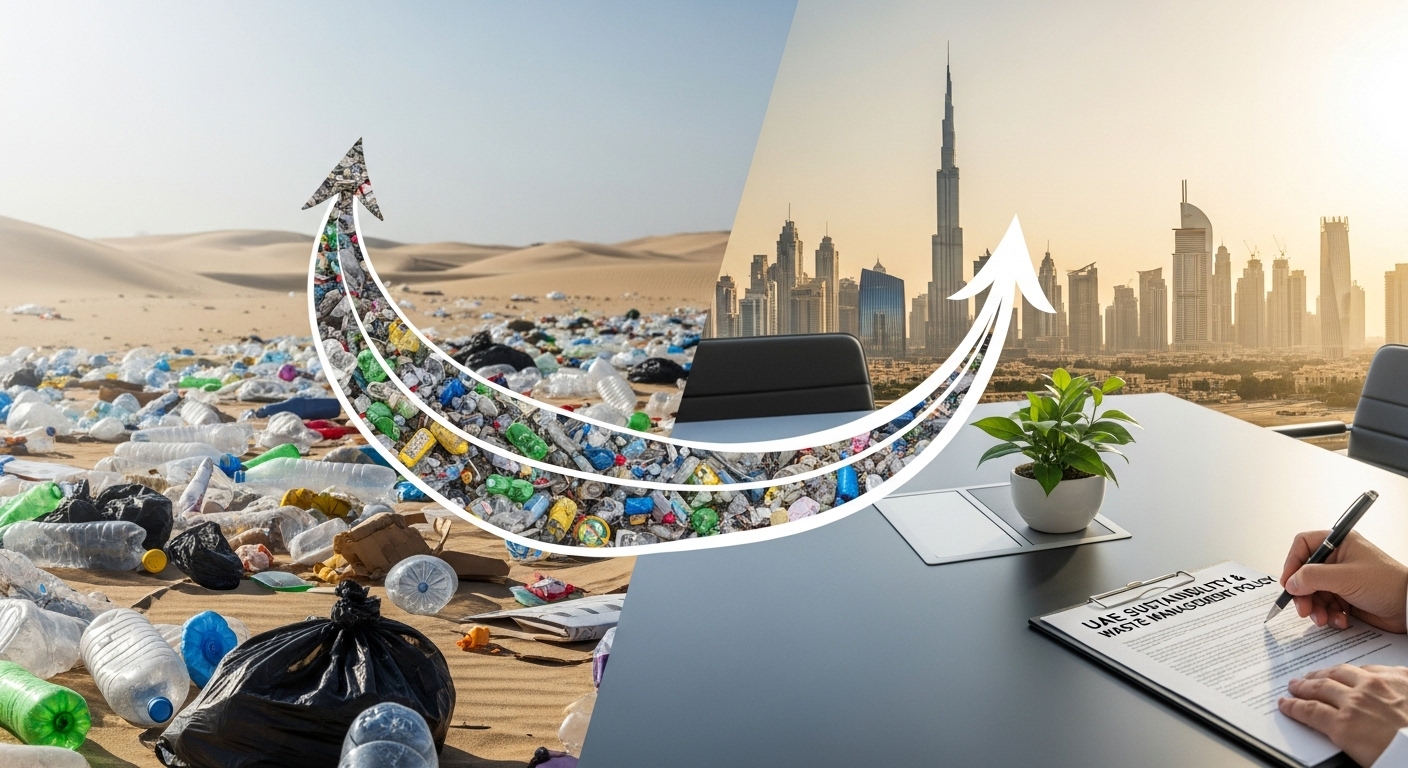
The UAE’s rapid economic growth and high-consumption lifestyle have historically generated a significant waste stream, with single-use plastics becoming a highly visible symbol of a linear “take-make-dispose” economy. However, a profound shift is underway. Driven by national strategy and a growing public consciousness, the UAE is moving decisively from a culture of disposal to one of circularity. This transition, “from plastic to policy,” encompasses a comprehensive suite of regulations, technological investments, and behavioral change campaigns, positioning the nation as an emerging leader in sustainable waste management and the fight against plastic pollution.
History
For decades, the UAE’s primary approach to waste was landfilling. The convenience of single-use products, coupled with a transient population, led to one of the highest per capita waste generation rates in the world. The turning point came with the launch of the UAE Vision 2021, which included clear targets for diverting waste from landfills. This was followed by the even more ambitious UAE Circular Economy Policy 2021-2031, which established a national framework for managing resources and waste more efficiently. The single-use plastic bag ban, implemented in 2024 across most emirates, was a landmark policy that signaled a new era of environmental regulation and public engagement.
Key Features
The UAE’s modern waste management strategy is built on a multi-layered approach:
- Regulatory Levers: The single-use plastic bag ban is the most visible policy. Several emirates have also introduced fees on other single-use items and are implementing Extended Producer Responsibility (EPR) schemes, making manufacturers responsible for the lifecycle of their products and packaging.
- Investment in Infrastructure: The UAE is investing billions in state-of-the-art Waste-to-Energy (WtE) plants. The Dubai Waste Management Centre in Warsan, once fully operational, will be the world’s largest, capable of processing 2 million tonnes of waste annually and powering over 120,000 homes.
- Recycling and Sorting: Advanced Material Recovery Facilities (MRFs) are being established to improve sorting efficiency. Public awareness campaigns and the placement of recycling bins across cities aim to increase public participation in source segregation.
- Circular Economy Initiatives: The focus is expanding beyond waste management to circular economy principles, promoting the repair, reuse, and remanufacturing of products to keep materials in use for as long as possible.
Cultural Significance
The shift in waste policy is driving a gradual but significant cultural change. For a society accustomed to convenience, the plastic bag ban was a jarring but necessary intervention that forced a public conversation about consumption habits. It has fostered a new environmental awareness, particularly among the youth, who are increasingly vocal about sustainability. The sight of people carrying reusable bags is becoming the new norm, symbolizing a collective commitment to a cleaner environment. This evolving mindset is crucial for the long-term success of the UAE’s sustainability goals, transforming environmental responsibility from a government mandate into a social value.
Modern Relevance
Effective waste management is directly tied to the UAE’s core national interests. It is critical for public health, urban livability, and the preservation of its natural landscapes and marine environments. Furthermore, it is an economic opportunity. The Waste-to-Energy plants contribute to energy diversification, while the circular economy is poised to create new green industries and jobs. The UAE’s hosting of COP28 placed a strong emphasis on the circular economy, showcasing its policies to a global audience and positioning itself as a knowledge hub for sustainable urban management in arid regions. The success of its waste management transition is a key metric for achieving its Net Zero by 2050 goal.
Conclusion
The UAE’s journey from plastic to policy is a compelling case study in modern environmental governance. It demonstrates a clear-eyed recognition that long-term prosperity is incompatible with a throwaway culture. By combining stringent policy with massive infrastructure investment and public engagement, the UAE is systematically building a more resilient and circular economy. While challenges remain, particularly in changing deep-seated behaviors, the direction is unequivocal. The nation is determined to ensure that its legacy is not one of landfills and plastic-choked shores, but of a clean, efficient, and sustainable model for managing resources in the 21st century.